Improv for the Workplace: Building Skills, Confidence, and Choice
Article by De’Vonte Perry, Community Engagement Manager and DSAmd Improv Director
Over the past two years, we’ve partnered with Fello (formerly The Arc Chesapeake Region) to bring improvisation into spaces serving individuals with intellectual and developmental disabilities across Maryland, including many members of Maryland's Down syndrome community.
What began as a short-term workshop series has grown into a meaningful collaboration rooted in trust, creativity, and a shared belief: people deserve not only access to employment, but agency within it.
This year, that partnership brought us to Severn, Linthicum, Annapolis, and Easton to facilitate inclusive improv workshops focused on workplace skills and employment exploration. While the goal was skill-building, the deeper intention was clear, to create space for reflection, choice-making, and self-advocacy in a system that too often prioritizes placement over fit.
Participants weren’t just practicing how to get a job.
They were exploring what kind of work actually works for them.
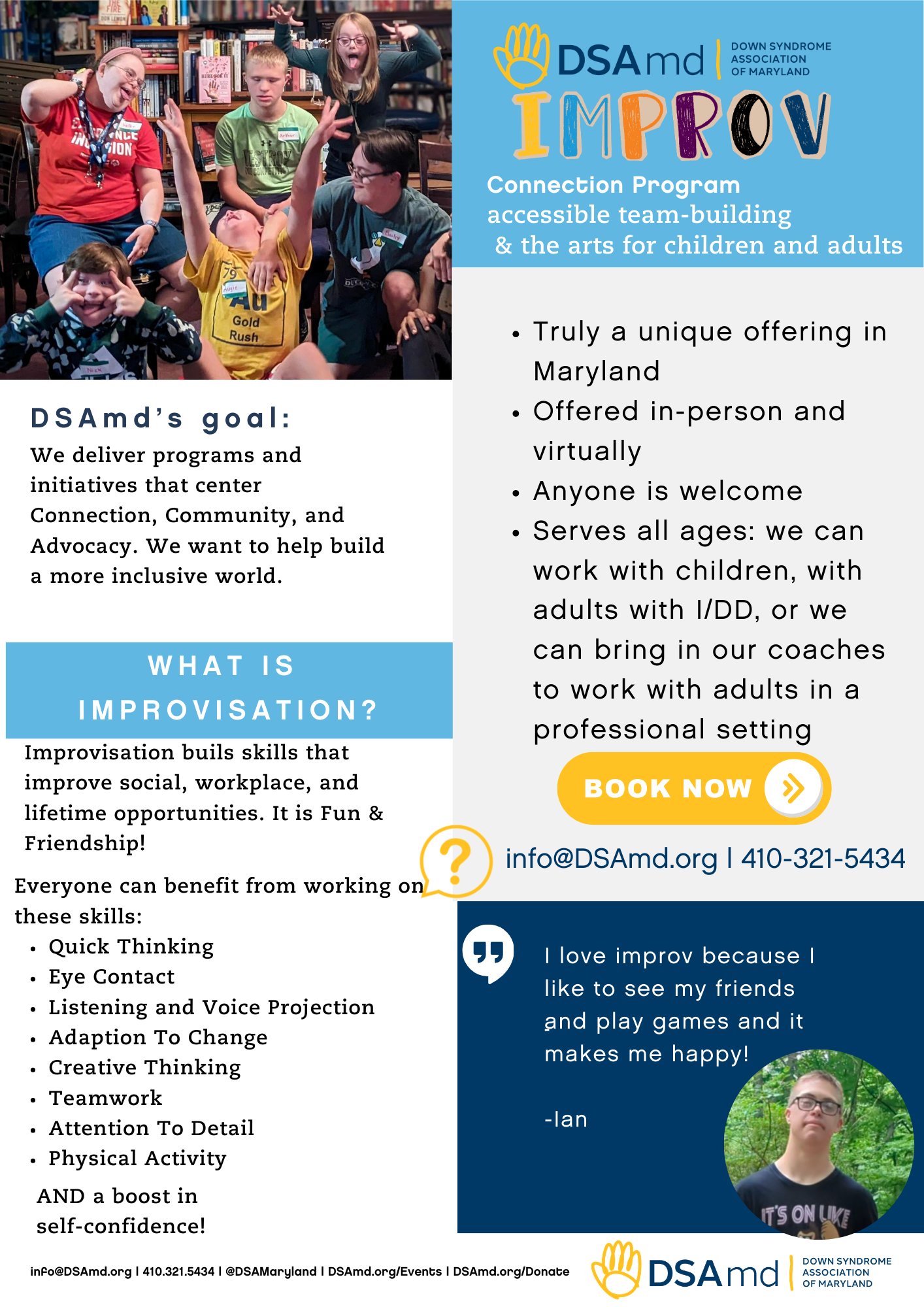
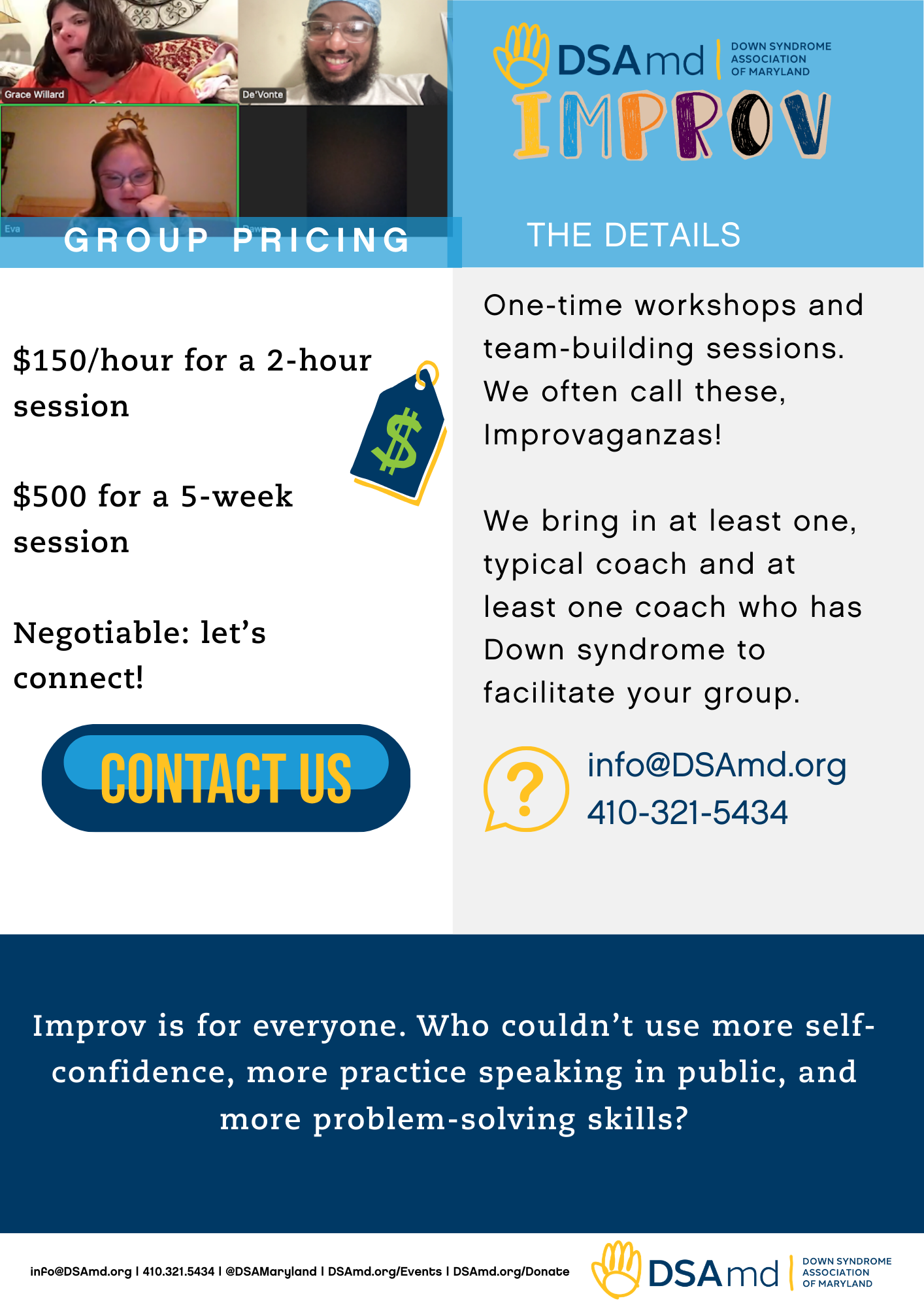
Can we share the DSAmd Improv for the Workplace program with your friends or group? We’d love that! Please reach out: info@DSAmd.org / 410-321-5434
From Readiness to Fit
Before any games began, we started with conversation.
Participants reflected on questions that are often missing from traditional employment preparation:
- Do you prefer fast-paced environments or quieter spaces?
- Do you like working with many people, a few people, or independently?
- Do you want to sit, stand, or move throughout the day?
- How far are you comfortable traveling for work?
- Do you want full-time, part-time, or are you still exploring?
There were no right answers, only honest ones.
This framing shifted the focus from compliance to self-awareness. It reinforced a central idea: a good job is not defined by productivity alone, but by sustainability, comfort, and dignity.
This approach intentionally complemented Fello’s Workforce Development program, which places the person at the center of career planning. Their team begins by asking similar questions; What do you enjoy? What environment fits you? What kind of life are you building? From resume support to interview preparation, on-the-job coaching, transportation training, and monthly check-ins, their model emphasizes long-term fit and stability, not just job placement.
Our customized improv agenda was designed to align with that philosophy.
Why Improv?
Improv is often mistaken for performance. In reality, it is practice.
Practice in listening.
Practice in adapting.
Practice in problem-solving.
Practice in expressing preferences.
Practice in making decisions in real time.
These are the same skills workplaces value.
Through structured games and role-play scenarios, participants strengthened communication, teamwork, adaptability, and confidence in a low-pressure environment where mistakes were reframed as information, not failure.
Customer service games emphasized asking clarifying questions before solving problems. Interview-style activities built confidence in self-expression. Humor-forward exercises like acting out the “world’s best” and “world’s worst” versions of a job opened meaningful discussions about expectations, boundaries, and workplace culture.
Importantly, participation was never limited to spoken language. Movement, gestures, communication devices, writing, pointing, and DSP collaboration were normalized and encouraged. Competence did not look one way. Communication did not sound one way.
Individuals and Direct Support Professionals played alongside one another, reinforcing that growth happens collectively, not hierarchically.
Participants and staff also received the agenda in advance, allowing games to extend beyond the workshop itself, into waiting rooms, car rides, and real-life preparation moments before interviews or work shifts.
Choice as an Outcome
One of the most powerful outcomes of these workshops wasn’t performance improvement. It was choice-making.
Improv constantly invites participants to ask:
What do I want to contribute?
How do I want to respond?
What feels right for me?
In employment settings, those same instincts become self-advocacy, asking questions during interviews, expressing preferences, setting boundaries, and recognizing when a job is or isn’t a good fit.
By the end of each workshop, participants weren’t just more comfortable in group settings. They were more confident articulating what they needed to succeed.
The Bigger Picture
Employment is often treated as a destination. These workshops reframed it as a process, one that includes exploration, self-knowledge, communication, and agency.
By pairing inclusive improv with Fello’s person-centered Workforce Development model, we created a space where skill-building and self-discovery could happen simultaneously.
This approach challenges deficit-based models of workforce development and asks a different question:
What happens when employment preparation is built around the whole person?
When people are supported in finding work that fits them, not just work that fills a role, the impact extends far beyond the workplace.
Because true workforce development begins with the person, and when employment is built around the whole person, it leads to sustainability, dignity, and confidence that lasts.
Interested? Reach out — let’s chat! info@DSAmd.org / 410-321-5434 call or text