
About Down Syndrome
Down syndrome is the most common genetic condition.
WHAT IS DOWN SYNDROME?
In every cell of the body, there is a nucleus that contains our genetic material. That material is organized into genes, and genes are grouped on structures called chromosomes. Most people have 46 chromosomes in each cell, arranged in 23 pairs - one set from each parent.
Down syndrome happens when a person has extra genetic material from chromosome 21. Most commonly, this means there are three copies of chromosome 21 instead of the usual two, which is why you may hear the term trisomy 21.
Some common physical traits can include:
Low muscle tone (hypotonia)
Smaller stature
A single deep crease across the palm
An upward slant to the eyes
Not everyone with Down syndrome has all of these traits, and the presence or absence of any physical feature does not predict a person’s abilities, personality, or quality of life.
HOW COMMON IS DOWN SYNDROME?
One in every 691 babies in the the United States is born with Down syndrome, making Down syndrome the most common genetic condition. Approximately 400,000 Americans have Down syndrome and about 6,000 babies with Down syndrome are born in the United States each year. Down syndrome occurs in people of all races, ethnicities, and backgrounds.
WHEN WAS DOWN SYNDROME DISCOVERED?
For centuries, people with Down syndrome have been alluded to in art, literature and science. The condition, however, was first formally described in 1866 by Dr. John Langdon Down, an English physician whose work led to the name “Down syndrome.” Although other people had previously recognized the characteristics of the syndrome, it was Down who described the condition as a distinct and separate entity.
In recent history, advances in medicine and science have enabled researchers to investigate the characteristics of people with Down syndrome. In 1959, the French physician Jérôme Lejeune identified Down syndrome as a chromosomal condition. Instead of the usual 46 chromosomes present in each cell, Lejeune observed 47 in the cells of individuals with Down syndrome. It was later determined that an extra partial or whole copy of chromosome 21 results in the characteristics associated with Down syndrome. In the year 2000, an international team of scientists successfully identified and cataloged each of the approximately 329 genes on chromosome 21. This accomplishment opened the door to great advances in Down syndrome research.
ARE THERE DIFFERENT TYPES OF DOWN SYNDROME?
There are three types of Down syndrome:
Trisomy 21 (nondisjunction)
Translocation Down syndrome
Mosaic Down syndrome
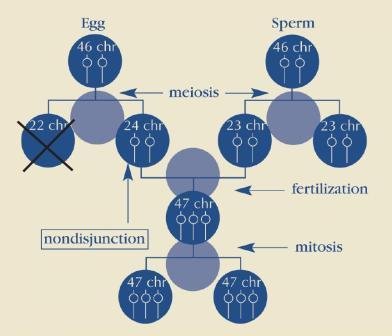
Trisomy 21 (Nondisjunction)
This is the most common time of Down Syndrome, accounting for about 95% of cases.
It is caused by an error in cell division called "nondisjunction." Nondisjunction results in an embryo with three copies of chromosome 21 instead of the usual two. Prior to or at conception, a pair of 21st chromosomes in either the sperm or the egg fails to separate. As the embryo develops, the extra chromosome is replicated in every cell of the body.

Translocation Down Syndrome
Translocation Down syndrome accounts for about 3–4% of all cases of Down syndrome. In this type, a full or partial extra copy of chromosome 21 attaches (or “trans-locates”) to another chromosome, most often chromosome 14, but sometimes 13, 15, 21, or 22. The total number of chromosomes in each cell is often still 46, but the extra genetic material from chromosome 21 is “stuck” to a different chromosome instead of existing as a separate extra chromosome. The extra chromosome 21 material still causes the characteristics of Down syndrome, just as in trisomy 21.
Mosaic Down Syndrome
Mosaicism occurs when nondisjunction of chromosome 21 takes place during one of the initial cell divisions after fertilization. When this occurs, there is a mixture of two types of cells, some containing the usual 46 chromosomes and others containing 47. Those cells with 47 chromosomes contain an extra chromosome 21.
Mosaicism accounts for about 1-2% of all cases of Down syndrome. Research has indicated that individuals with mosaic Down syndrome may have fewer characteristics of Down syndrome than those with other types of Down syndrome. However, broad generalizations are not possible due to the wide range of abilities people with Down syndrome possess.
WHAT CAUSES DOWN SYNDROME?
Regardless of the type of Down syndrome a person may have, all people with Down syndrome have an extra, critical portion of chromosome 21 present in all or some of their cells. This additional genetic material alters the course of development and causes the characteristics associated with Down syndrome.
The causes of nondisjunction and translocation are currently unknown, but research has shown that it increases in frequency as a woman ages. However, due to higher birth rates in younger women, 80% of children with Down syndrome are born to women under 35 years of age.
There is no definitive scientific research that indicates that Down syndrome is caused by environmental factors or the parents' activities before or during pregnancy.
The additional partial or full copy of the 21st chromosome which causes Down syndrome can originate from either the father or the mother. Approximately 5% of the cases have been traced to the father.
Down syndrome is not caused by something parents did or did not do before or during pregnancy.
WHAT IS THE LIKELIHOOD OF HAVING A CHILD WITH DOWN SYNDROME?
Down syndrome occurs in people of all races and economic levels, though older women have an increased chance of having a child with Down syndrome. A 35 year old woman has about a one in 350 chance of conceiving a child with Down syndrome, and this chance increases gradually to 1 in 100 by age 40. At age 45 the incidence becomes approximately 1 in 30. The age of the mother does not seem to be linked to the risk of translocation.
Since many couples are postponing parenting until later in life, the incidence of Down syndrome conceptions is expected to increase. Therefore, genetic counseling for parents is becoming increasingly important. Still, many physicians are not fully informed about advising their patients about the incidences of Down syndrome, advancements in diagnosis, and the protocols for care and treatment of babies born with Down syndrome.
DOES DOWN SYNDROME RUN IN FAMILIES?
All 3 types of Down syndrome are genetic conditions (relating to the genes), but heredity is not a factor in trisomy 21 (nondisjunction) and mosaicism. However, in one third of cases of Down syndrome resulting from translocation there is a hereditary component.
WHAT IS THE LIKELIHOOD OF HAVING A SECOND CHILD WITH DOWN SYNDROME?
Once a woman has given birth to a baby with trisomy 21 (nondisjunction) or translocation, it is estimated that her chances of having another baby with trisomy 21 is 1 in 100 up until age 40.
The risk of recurrence of translocation is about 3% if the father is the carrier and 10-15% if the mother is the carrier. Genetic counseling can determine the origin of translocation.
HOW IS DOWN SYNDROME DIAGNOSED?
Prenatally
There are two categories of tests for Down syndrome that can be performed before a baby is born: screening tests and diagnostic tests. Prenatal screens estimate the chance of the fetus having Down syndrome. Most of these tests only provide a probability. Diagnostic tests can provide a definitive diagnosis with almost 100% accuracy.
Most screening tests involve a blood test and an ultrasound (sonogram). The blood tests (or serum screening tests) measure quantities of various substances in the blood of the mother. Together with a woman's age, these are used to estimate her chance of having a child with Down syndrome. These blood tests are often performed in conjunction with a detailed sonogram to check for "markers" (characteristics that some researchers feel may have a significant association with Down syndrome). New advanced prenatal screens are now able to detect chromosomal material from the fetus that is circulating in the maternal blood. These tests are not invasive (like the diagnostic tests below), but they provide a high accuracy rate. Still, all of these screens will not definitively diagnose Down syndrome. Prenatal screening and diagnostic tests are now routinely offered to women of all ages.
The diagnostic procedures available for prenatal diagnosis of Down syndrome are chorionic villus sampling (CVS) and amniocentesis. These procedures, which carry up to a 1% risk of causing a spontaneous termination (miscarriage), are practically 100% accurate in diagnosing Down syndrome. Amniocentesis is usually performed in the second trimester after 15 weeks of gestation, CVS in the first trimester between 9 and 11 weeks.
At Birth
Down syndrome is usually identified at birth by the presence of certain physical traits: low muscle tone, a single deep crease across the palm of the hand, a slightly flattened facial profile and an upward slant to the eyes. Because these features may be present in babies without Down syndrome, a chromosomal analysis (karyotype or similar test) is done to confirm the diagnosis. To obtain a karyotype, doctors draw a blood sample to examine the baby's cells. They use special tools to photograph the chromosomes and then group them by size, number, and shape. By examining the karyotype, doctors can diagnose Down syndrome. Another genetic test called FISH can apply similar principles and confirm a diagnosis in a shorter amount of time.
LIFE WITH DOWN SYNDROME
Individuals with Down syndrome are becoming increasingly integrated into society and community organizations, such as school, health care systems, work forces, and social and recreational activities. Individuals with Down syndrome possess varying degrees of cognitive delays, from very mild to severe. Most people with Down syndrome have cognitive delays that are mild to moderate.
Due to advances in medical technology, individuals with Down syndrome are living longer than ever before. In 1910, children with Down syndrome were expected to survive to age nine. Now, with recent advancements in clinical treatment, most particularly corrective heart surgeries, as many as 80% of adults with Down syndrome reach age 60, and many live even longer.
With the right supports, people with Down syndrome can learn, grow, work, form meaningful relationships, and make their own choices about their lives.
The biggest barriers people with Down syndrome face are often not their chromosomes, but gaps in access, services, and inclusive opportunities. Organizations like the Down Syndrome Association of Maryland (DSAmd) work alongside families, self-advocates, and community partners to reduce those barriers and build a more inclusive Maryland for everyone.